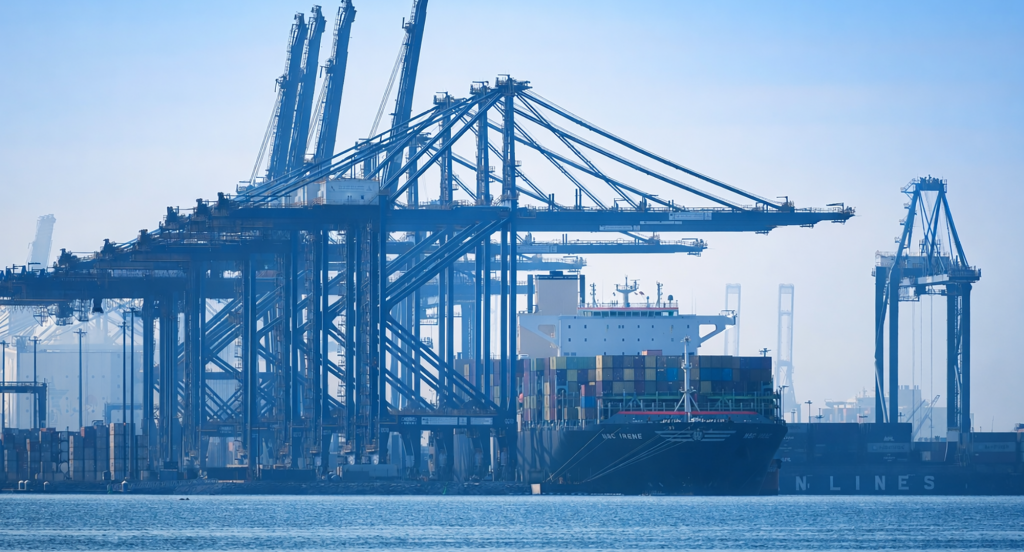
Gemini Cooperation partners, Hapag-Lloyd and Maersk, have announced revised routing for one of their joint services through the Suez Canal, marking progress toward the resumption of commercial shipping through the Red Sea.
A recent Hapag-Lloyd advisory noted that the shared service linking India, the Middle East, and the Mediterranean will begin mid-February 2026. The communication also stated that “all voyages will be supported by naval assistance”.
The return of transits to the Red Sea is expected to deliver significant time savings, reducing the journey by more than 3,000 nautical miles. As reported by gCaptain, Westbound sailings from Mundra in India to Europe will be reduced by up to 19 days, while Eastbound voyages are expected to shorten by approximately seven days.
A limited number of Red Sea and Suez Canal transits had already resumed on a trial basis prior to the Gemini Cooperation announcement, with CMA CGA being the first alliance-operated ocean carrier to restart crossings while Maersk completed two trial transits. However, CMA CGM recently rerouted three services away from the Suez Canal toward the Cape of Good Hope, citing the highly uncertain global environment.
The resumption of voyages through the Red Sea will affect schedule reliability metrics. The Gemini Cooperation has set itself a target to achieve a schedule reliability above 90%. Additionally, both Hapag-Lloyd and Maersk also signaled their intention to route two additional services through the Red Sea and Suez Canal at a later phase.
Xeneta’s Chief Analyst, Peter Sand, noted that a full-scale return to transits via the Suez Canal could effectively release an additional 6-8% of global container shipping capacity.
Sea-Intelligence’s CEO Alan Murphy had cautioned, “This suggests that the initial phase of Suez routing will be characterized by a chaotic rush to reintegrate these ports back into the Asia-Europe network, creating significant risk of terminal congestion, as lines reactivate these service loops.”
Source: Hapag-Lloyd, gCaptain, Maersk, Xeneta, Sea-Intelligence