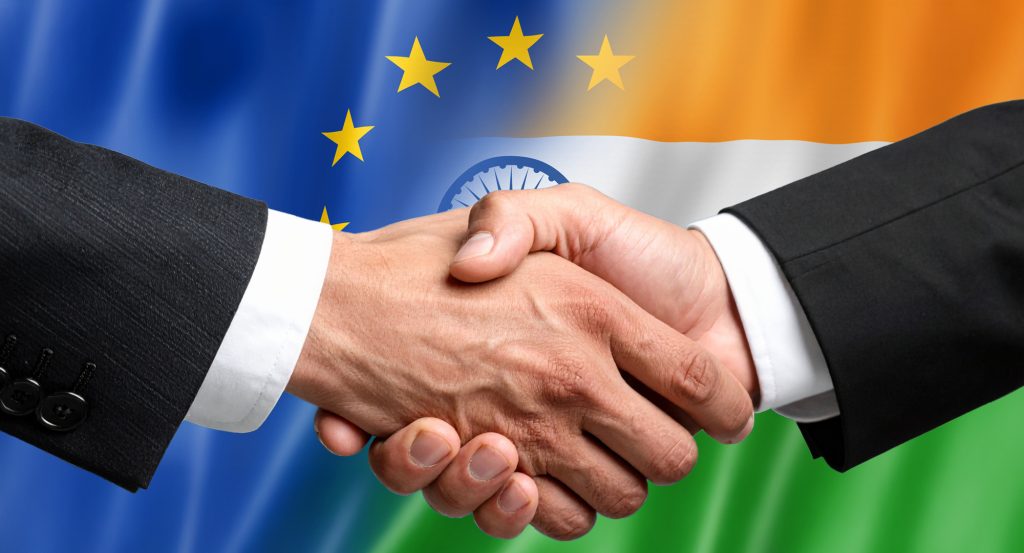
The 27-nation European Union (EU) and India signed a free trade agreement on January 27, 2026, concluding nearly two decades of negotiations. The deal brings together two economies that represent a combined market covering 2 billion people and 25% of global GDP.
“The EU and India make history today, deepening the partnership between the world’s biggest democracies. We have created a free trade zone of 2 billion people, with both sides set to gain economically,” announced European Commission President, Ursula von der Leyen.
Under the agreement, tariffs will be eliminated or reduced on 97% of EU exports to India and more than 99% of Indian exports to Europe. The deal is expected to double EU goods exports to India by 2032 and reduce duties on European products by approximately €4 billion per year. “The agreement will grant EU companies privileged access to the Indian services market, including key sectors such as financial services and maritime transport,” according to the EU’s press release.
In the context of global logistics, the most noticeable effect will be in container shipping, since the economic advantages will boost cargo movement between regions. As reported by gCaptain, major Indian West coast gateways are well positioned to handle growing volumes bound for Europe. European hubs including Rotterdam, Antwerp, Hamburg, Piraeus, and Valencia are expected to benefit on the inbound side. The positive outlook comes as widespread freight disruptions continue across Europe, with severe weather causing service interruptions, slower terminal operations, and congestion.
According to a report by gCaptain, the agreement creates conditions for additional direct deep-sea services linking India and northern Europe, potentially reducing reliance on transshipment hubs such as Singapore and Colombo. Existing Asia–Europe loops may also be reconfigured, with more Indian port calls and fewer Chinese rotations as European importers accelerate sourcing diversification.
Strategically, the agreement reinforces Europe’s push to reduce its reliance on Chinese manufacturing. For shipping lines, it signals a rebalancing of Asia-Europe trade patterns, with cargo increasingly originating from Indian rather than Chinese ports, fundamentally altering vessel deployment strategies.
Source: European Commission, gCaptain