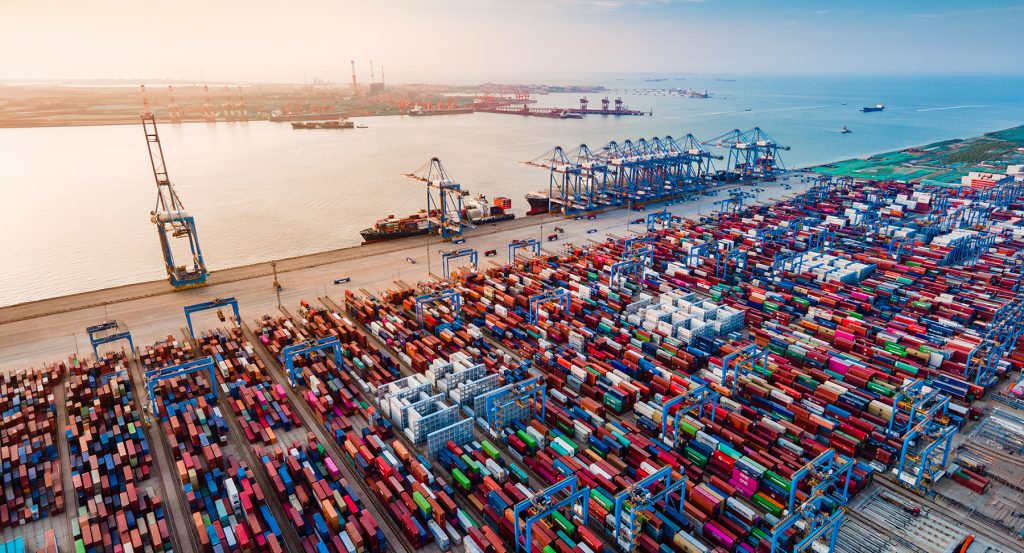
Global trade is expected to continue growing through 2027, but uneven demand, shifting trade patterns, and record levels of newbuilding orders are creating a more challenging outlook for container shipping.
According to the International Monetary Fund (IMF), global economic growth is projected at 3.1% in 2026 and 3.4% in 2027. IMF also pointed out that economic performance is uneven with countries affected differently.
“We see a growing divide. Countries benefiting from the AI-driven investment boom or favorable terms of trade are doing relatively well, while many energy importing and lower income economies are facing a much more challenging environment,” described Deniz Igan, Division Chief at the IMF’s Research Department.
Citing the IMF’s October 2026 World Economic Outlook, Sea-Intelligence reported that trade volume growth is expected to moderate from 5.0% in 2025 to 4.7% in 2027 while import growth in advanced economies is projected to slow from 5% in 2026 to 4.2% in 2027. Sea-Intelligence observed that this demand growth would not be sufficient to absorb additional vessel capacity entering the market. Since the beginning of the year, ocean carriers have continued with their newbuilding commitments. According to reporting from The Loadstar, the containership orderbook now represents 46.5% of the active fleet.
Trade flows have also adjusted to changes U.S. trade policy. Following U.S. tariffs measures introduced in 2025, Sea-Intelligence reported that Chinese exports to the U.S. declined by -22% over a 12-month period, while U.S. exports to China fell by -25%. Some of that trade shifted to other markets, with Sea-Intelligence reporting that Chinese producers redirected 52% of their products to other Asian countries, and U.S. exporters redirected 17%.
“Instead of shipping directly from China to the US, manufacturers are now sending parts to countries like Vietnam, Malaysia, and Indonesia. The products are put together there and then shipped to the U.S. This keeps trade volumes steady, but for the manufacturers and shippers, this makes logistics much more complicated, adds extra stops at ports, and increases costs,” said Alan Murphy, Sea-Intelligence’s CEO.
AI investment is also changing cargo composition Sea-Intelligence pointed out. “While the physical microprocessors are normally moved by air, the heavy materials needed to build AI data centers are moved in ocean containers, providing important heavy cargo for shipping lines,” said Murphy.
Source: IMF, IMF World Economic Report, Sea-Intelligence, The Loadstar