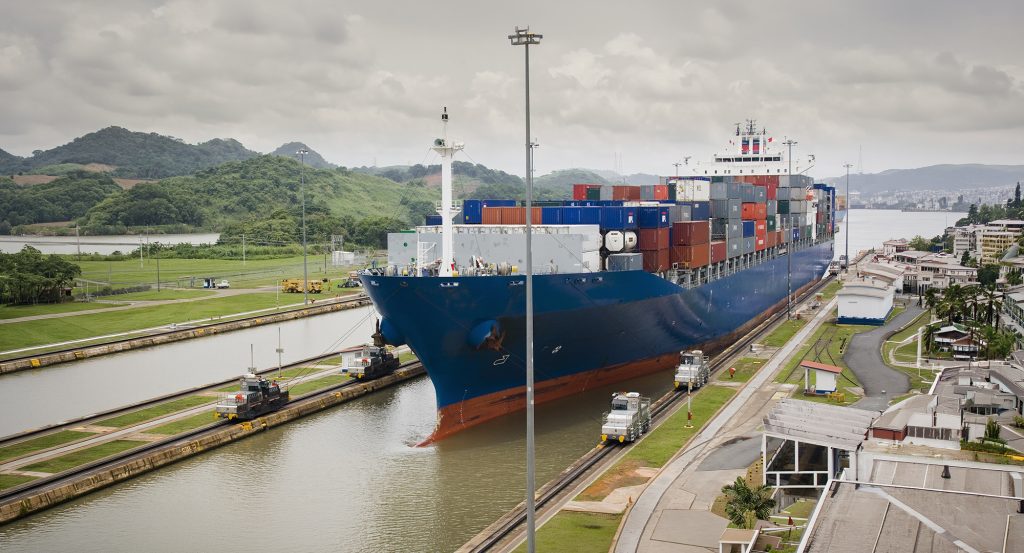
According to reporting by gCaptain, the Panama Canal Authority (ACP) has announced additional draft reductions for vessels transiting the Neopanamax locks due to declining water levels in Gatun Lake while adapting its operations in anticipation of a severe El Niño event.
The Neopanamax locks accommodate some of the world’s largest vessels, including containerships, LNG carriers and tankers. As a result, the revised draft limits could reduce vessel loading capacity, effectively removing capacity from the market at a time when global supply chains are already facing multiple operational challenges.
The draft reductions are coinciding with strong import demand that has placed added pressure on vessel capacity across the Asia–U.S. East Coast trade. As reported by American Shipper, U.S. import activity continues to exceed traditional seasonal patterns, contributing to a drawn-out peak shipping season.
At the same time, ongoing disruption in the Red Sea and the continued closure of the Strait of Hormuz have shifted cargo flows onto alternative routes, increasing demand for available vessel capacity, and putting additional pressure on key trade corridors, including the Panama Canal.
While the ACP has stated that the revised draft limits will not reduce the number of daily vessel transits, The Maritime Executive reported signs of increasing congestion, with the ACP’s online dashboard showing a growing number of vessels waiting to transit the canal.
Capacity pressures are also being amplified by congestion elsewhere in the global shipping network. According to Linerlytica’s Market Pulse, global port congestion has climbed to 4.17 million TEU, equivalent to 12.1% of the world’s containership fleet. The report also noted that more than 2.4 million TEU of containership capacity across North Asia has been affected by Typhoon Dolphin, which struck China’s eastern coast on August 9, 2026.
According to Linerlytica, vessel delays are expected to persist, with Ningbo and Shanghai among the most heavily impacted ports. Congestion has also spread across Southern China and could take several weeks to clear as carriers work through accumulated vessel backlogs.
Both the U.S. National Oceanic and Atmospheric Administration (NOAA) and the World Meteorological Organization have warned that the El Niño weather pattern is expected to strengthen. In a recent advisory, the NOAA said, “El Niño is strengthening, with a greater than 90% chance of a very strong event during the Northern Hemisphere fall and winter 2026-27.”
Sources: gCaptain, American Shipper, Linerlytica