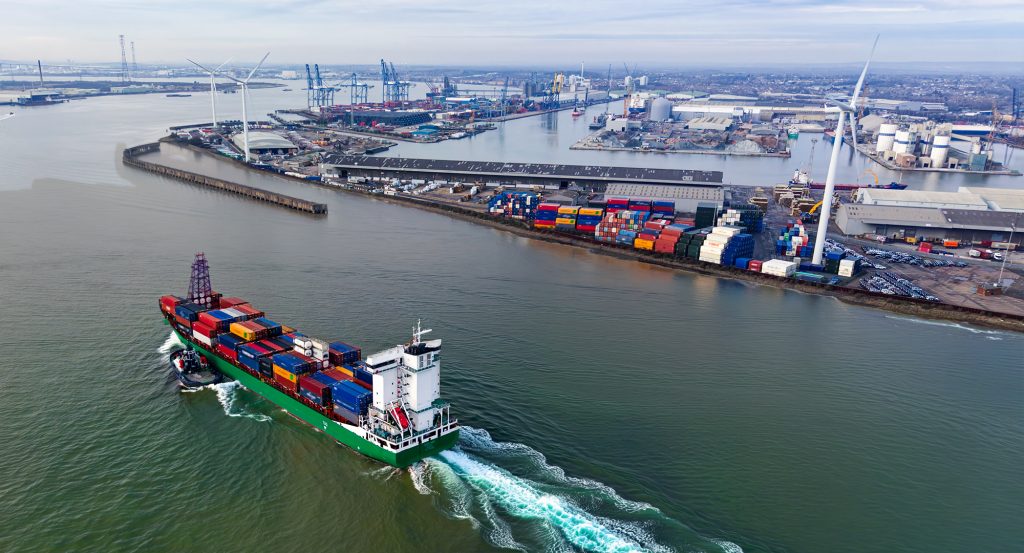
New data points to intensifying competitive pressures around fleet growth and access to sustainable fuels for European shipping. As reported by the European Community Shipowners’ Association (ECSA), European-controlled vessels account for 34.5% of the global fleet, equivalent to approximately 570.5 million gross tons. The ECSA study noted that European operators control 45% of the world’s container ship capacity.
Despite this scale, Europe’s relative position is at a turning point. While the European-controlled fleet has expanded by 11% since 2018, its share of global tonnage has declined by four percentage points on a rolling five‑year basis. Over the same eight-year period, the global fleet grew by 30%, which ECSA said was “driven largely by rapid growth in the Asia-Pacific region”.
“Europe is much more trade-oriented than the U.S. or China,” the ECSA report noted. The European Union (EU) is depends heavily on maritime transport, with 76% of the EU’s external trade carried by sea.
At the same time, climate policy discussions around the maritime industry’s pathway to decarbonization are ongoing. According to the International Maritime Organization (IMO), shipping is responsible for approximately 2.9% of global greenhouse gas emissions.
Encouragingly, investment patterns have suggested there is some progress. Data from the World Shipping Council’s Dual‑Fuel Fleet Dashboard showed that 78% of container ships on order are dual-fuel capable.
European shipowners have taken the lead in this transition, holding the largest share of sustainable fuel-capable vessels on order globally.
The ECSA also noted a gap in sustainable fuel availability. According to data cited by ECSA, 74% of the fuel required to power these vessels is produced in Asia, compared with just 10% in Europe.
Source: ECSA, World Shipping Council