
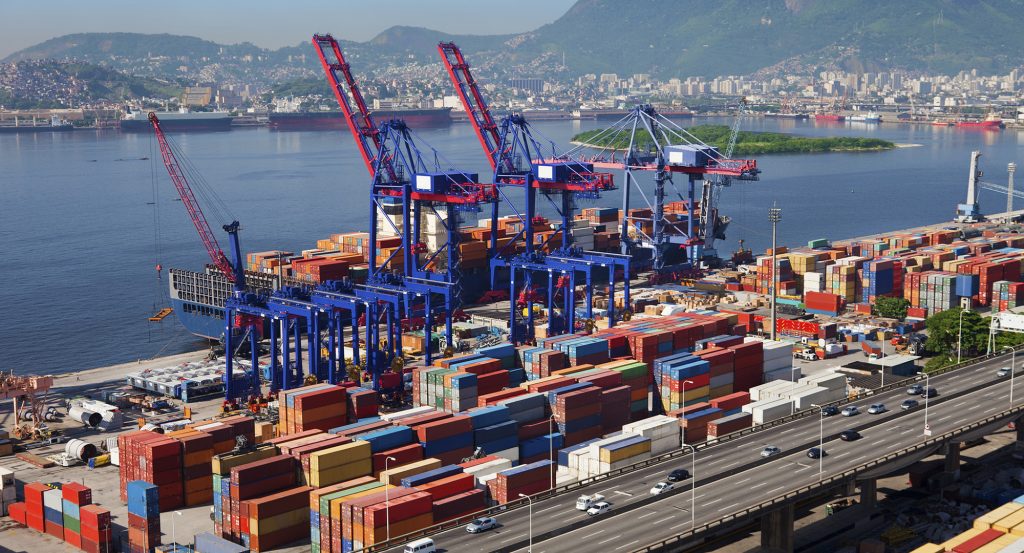
Global port congestion is tying up about 10% of the world’s fleet at anchorages. These conditions are expected to support carrier plans for rate increases in July, according to reporting from The Loadstar.
Shanghai is experiencing delays of up to five days, while Taiwan is facing both congestion and overbooking, The Loadstar reported. According to the American Journal of Transportation, citing Drewry’s Intra-Asia Container Index released on June 11, said port utilization at major transshipment hubs such as Singapore are at critical levels. Drewry also noted that large volumes of displaced containers have created network imbalances and limited the repositioning of empty equipment into South Asian markets.
In India, operational strain is intensifying across its Western ports, including Jawaharlal Nehru, Kandla, and Mundra, which have become chokepoints for both outgoing and incoming containers, as reported by the ETSupplyChain. According to The Loadstar, a combination of vessel bunching, rail delays, trucking shortages, and rising yard density is creating significant landside bottlenecks. These challenges are further worsened by driver shortages and elevated fuel costs, adding to inland congestion.
The effects are extending beyond Asia. While North America accounts for roughly 5% of global anchorage capacity, localized disruption is emerging along the U.S. East Coast. In Europe, Antwerp continues to work through accumulated backlogs, while Hamburg faces ongoing infrastructure constraints. According to Linerlytica, as cited by The Loadstar, worsening congestion across Asia and Europe could lead to ad hoc blank sailings in July.
Drewry’s World Container Index assessment released on June 25 noted that congestion at major Asian and European hubs have limited capacity and vessel availability. “As a result, carriers are successfully implementing surcharges, including higher FAK levels and PSS, creating upward pressure on spot rates,” Drewry highlighted.
At an operational level, ocean carriers have taken measures with adapted schedules to absorb the operational strain from the diversions. According to Sea-Intelligence, the buffer time is built into schedules to absorb delays linked to diversions around the Red Sea and the Strait of Hormuz. Alan Murphy, Sea-Intelligence’s CEO, observed that the adjustments can result in “negative delay” in performance metrics, effectively masking the true extent of network disruption. He said this approach has continued into 2026 as a means for shipping lines to absorb the operational strain from the diversions.
Source: The Loadstar, American Journal of Transportation, Drewry, ETSupplyChain, Sea Intelligence