
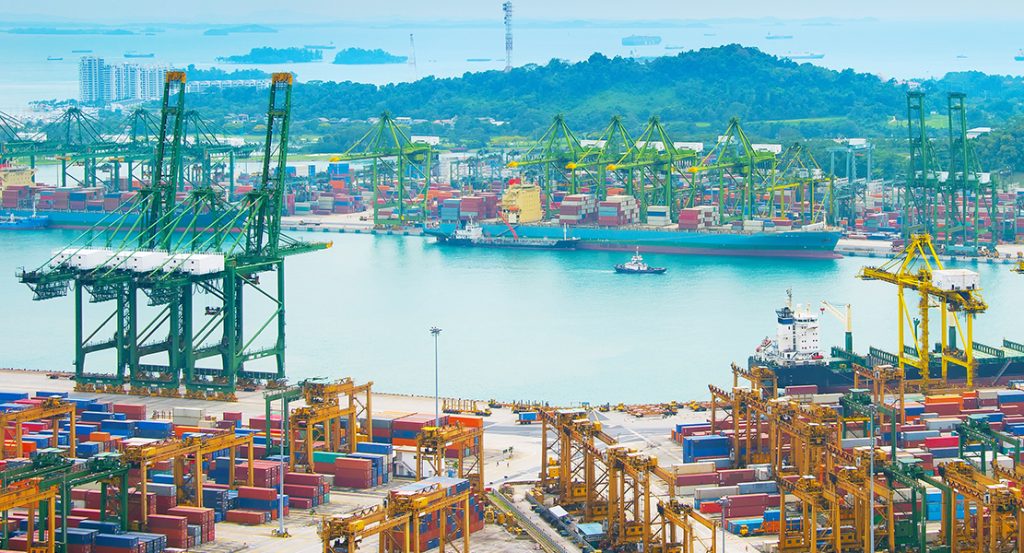
Ocean carriers are moving capacity away from Asia’s largest transshipment hubs and redirecting services toward secondary regional gateways. What began as a response to disruption is now shaping into a permanent adjustment of liner networks.
According to Sea-Intelligence’s analysis of the United Nations Conference on Trade and Development’s (UNCTAD) 2026-Q2 Port Liner Shipping Connectivity Index (PLSCI), key Straits hub ports such as Singapore, Port Klang, and Tanjung Pelepas recorded declines in connectivity ranging approximately -2% to -7% during the second quarter of 2026. These ports had previously handled elevated volumes during the 2024–2025 disruption period, when congestion, equipment shortages, and schedule instability schedules led carriers to concentrate calls at larger, more resilient terminals.
China’s primary gateway ports also saw declines. Connectivity at Shanghai and Ningbo fell by around -2% over the same period. “Shipping lines are actively reorganizing port connectivity by concentrating on regional relay ports and specific export gateways, while simultaneously cutting back on the routes that were previously built up around major transshipment hubs,” said Alan Murphy, CEO of Sea-Intelligence.
The restructuring of service have placed export gateways in closer proximity to key production hubs, as reported by splash247. Vietnam’s Haiphong, Thailand’s Laem Chabang, India’s Pipavav, Ennore and Visakhapatnam, and East Africa’s Djibouti are main beneficiaries of the capacity redistribution.
The ongoing disruption around the Red Sea and the Strait of Hormuz has reinforced the need for flexible and distributed networks. Indian Subcontinent ports such as Mundra, Nhava Sheva, and Colombo have similarly registered weaker connectivity, The Loadstar reported.
According to Sea-Intelligence, the shift in cargo flows is giving carriers room to optimize their networks. “Now, with secondary Indian and Middle Eastern gateways successfully absorbing the latest wave of relay cargo, shipping lines have the operational breathing space needed to finally optimize these eastern networks, resulting in a synchronized connectivity decline across the Straits,” said Murphy.
Source: Sea-Intelligence, splash247, The Loadstar