
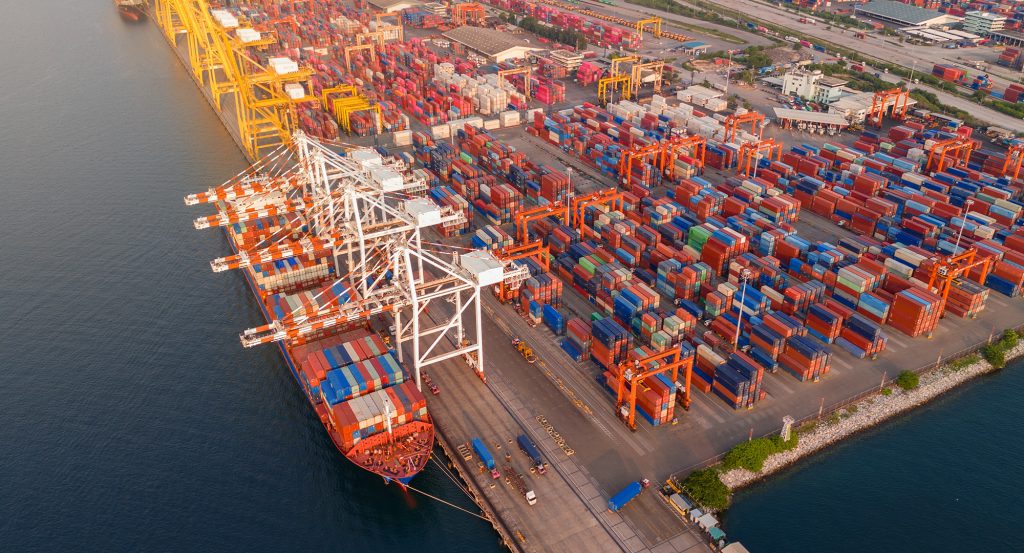
Congestion across Asia is beginning to ease at some of the region’s major hubs, but it has not eliminated congestion and rate pressures at smaller Southeast Asian ports. The Loadstar reported that major ports in China and Singapore have been able to absorb much of the disruption. “Following several weeks of severe port congestion caused by typhoons and operational disruptions, conditions at major Chinese ports have started to improve,” Drewry wrote in its November 5 assessment. The improvement is reflected in Drewry’s Intra-Asia Container Index, which recorded rate declines on the Shanghai–Jakarta and Shanghai–Busan routes.
However, some of the disruption has shifted further along the network. Smaller Southeast Asian ports are contending with vessel delays and operational constraints, with reporting by The Loadstar noting elevated rates on services from Shanghai to Ho Chi Minh City, Jakarta, and Laem Chabang as examples of where localized pressure remains.
The scale of disruption, according to splash247 citing Sea-Intelligence data, stands at 8.5% of the global containership fleet, equivalent to approximately 3 million TEUs. The disruption was caused by repeated typhoons that struck major Asian ports, with effects subsequently spreading through the networks.
splash247 reported that port omissions and vessel bunching shifted delays into transshipment hubs and downstream ports across Southeast Asia and the Indian Subcontinent. Herbert Lee, Shipco’s Regional Director for Hong Kong & South China, has observed the resulting impact on feeder-dependent cargo movements, noting that many South China shipments rely on feeder connections to Shanghai before connecting with ocean vessels for their final destinations, including cargo moving from Xiamen to Chennai.
Unwinding the congestion could take months. Reporting by slash247, citing Sea-Intelligence, reported that it could take seven to 10 months for congestion to return to the low levels seen in June 2025, or six to eight months simply to return to end-2025 conditions.
The timing adds another challenge. Sea-Intelligence warned that Asian congestion may only be partially relieved before the Chinese Lunar New Year, which falls on February 6, 2027, 11 days earlier than the previous year. This leaves less time for networks to recover ahead of the typical pre-holiday shipping surge as shippers rush to move their shipments.
Source: The Loadstar, Drewry, splash247, Shipco Transport